Showing posts with label trail riding. Show all posts

Monday, October 31, 2011

The Poudre Trail: A little bit of country in the city


As winter approaches, finding places to trail ride becomes more difficult. The trails get muddy, mountain trails are hard to access because of road closures and snow, and there is less time to travel to the trails as the days get shorter.

Fort Collins has an extensive system of trails throughout the city, however, and a few of them are open to horse travel. One of the city's best paths for horses is the Poudre Trail, great for an afternoon ride during fall or winter.

This east-west trail on the far north end of town parallels the Cache la Poudre River. The trail starts in LaPorte and heads past Old Town all the way to the Riverbend Ponds natural area off Mulberry Street and Timberline Road. Because this urban trail has a few road crossings and other obstacles, it's better for more advanced riders and horses. It offers a chance to teach horses about water crossings, bikes, dogs, people, and pavement. It's also a great challenge for a horse which is doing well on mountain trails.

Horse trailers can be parked in a number of places. To start at the beginning of the trail, park in LaPorte. A small parking lot is off Overland Trail just west of 54G. If that lot is full, equestrians can park in the supermarket lot just to the east, but must be sure to clean up after horses. Starting from this point means crossing a long and noisy bridge. This may not be the best choice for horses which are not calm and ready to behave immediately off the trailer.

A better choice is at the trailhead on Taft Hill Road. The fairly large lot has spaces designed for horse trailers. From the trailhead there, the trail heads south. Most of the route features two parallel trails -- one paved, one dirt -- to provide options for where to walk. This trail is popular, so equestrians will encounter people riding bikes, walking dogs and jogging.

The first major obstacle on this part of the trail is a tunnel. Although short, it's made from steel, so it is loud and echoes as horses approach and walk though it. If a horse becomes  nervous, it may be safer to dismount and walk the animal through it the first time.

The next obstacle is at Shields Street, which presents two choices: Walking under the road, a low bridge and blind corner, or crossing the road and watching for traffic.

After shields, Poudre Stables is on the right and the river is on the left. Some of the dirt side trails offer chances to play in the river or cross one of the many bridges and use the natural areas on the Cache la Poudre's north side.

The path winds down along the river, and crosses under railroad tracks and College Avenue. Those crossings are very low, so riders should dismount to be safe.

The trail eventually connects to Linden Street and passes New Belgium Brewing. A creative rider might be able to find a way to get a sample from the brewery before continuing on the ride.

The trail continues along a natural area and golf course until it connects to Mulberry Street and Lemay Avenue. Horses should be very used to cars and traffics to continue past here, because riders may have to travel on or near the busy streets. The trail concludes just past Timberline Road in the Riverbend Ponds Natural Area.

With all the side trails and adjacent natural areas, every trip down the Poudre Trail will be slightly different and can provide horses and riders many new challenges, both natural and human made.


Monday, October 17, 2011

Red Mountain Open Space


Horseback riders can find winding trails of varied lengths and scenic rock formations in one of Larimer County's most recently opened tracts.

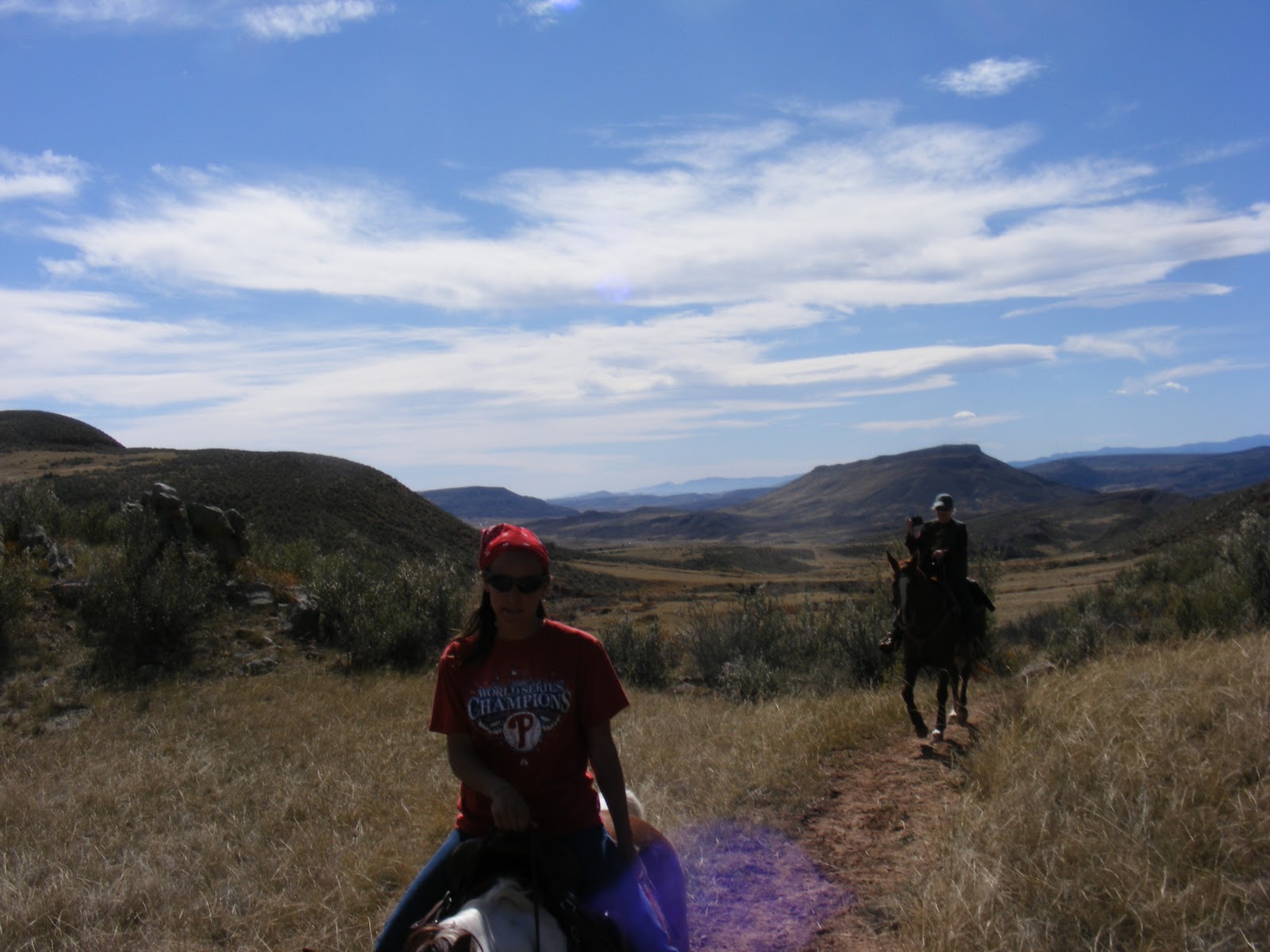
Red Mountain Open Space opened to the public in 2009 through efforts of the Larimer County Mountains to Plains Project. The tract is located about 25 miles north of Fort Collins on County Road 23. While the drive is a bit long, the experience of riding in this area is worth it.


The main trail, the Sinking Sun Trail, leaves from the northeast side of the horse trailer parking lot and heads north through the valley. Multiple hills and creek beds keep the trail interesting and challenging for the horses. The exposed rock on the hills comes in striking red and white, and provides beautiful scenery for riders.

Several options await equestrians following the Sinking Sun Trail.

 The Big Hole Wash Trail crosses east-west through the valley. To the east it enters the Soapstone Prairie Natural Area, with its miles of trails. To the west is the other side of the open space, which features a creek and many more trails. A couple of short loops head into the hills on the valley's west side.

For a longer ride, the Ruby Wash Trail heads north through a gorgeous, winding canyon of red-layered rocks, and eventually reaching the Salt Lick Trail, which connects to the Sinking Sun Trail.

At the junction of the Ruby Wash and Salt Lick trails, the Cheyenne Rim Trail continues north into Wyoming and over to the Soapstone Prairie Natural Area. The Cheyenne Rim Trail loops back and connects to the Big Hole Wash Trail.

The trails are wide and easy to ride in the valley areas, providing lots of opportunities for letting a horse out for a run or long trot. The trails provide options for long or short rides. From the parking lot, it's about 4 miles to the Wyoming border, and the trail can be done at any pace.

This area is a beautiful choice for a weekend day ride. No dogs are allowed in the open space -- not even on leashes. Riders should also be on the lookout for rattlesnakes, which are seen out there fairly often.

Red Mountain Open Space is a wildlife preserve, so riders may see deer, elk or other animals. This area also is prone to high winds and quickly changing weather, so visitors should be prepared with layers of warm clothing.

A few trails on the tract are not open to horses, so riders should check maps and any signs in the area to make sure a trail is appropriate.

More information, including complete directions from Fort Collins or Interstate 25, is online at http://www.larimer.org/parks/red_mountain.htm.

 Happy trails!


Tuesday, October 11, 2011

Eagles Nest: Scenery and Wildlife From the Saddle

If you are looking for a great place to take horses trail riding, I highly recommend the Eagles Nest Open Space in Livermore, Colo. Scenic views, varied terrain and solitude await just minutes from the city.
 
From Fort Collins, follow U.S. Highway 287 to Livermore and turn left onto Red Feather Lakes Road. The road to the open space is less than a quarter-mile from Highway 287. A big wooden sign welcomes you to the tract at the start of a dirt road. Follow the road for about a mile to the parking lot and trailhead.

Make sure your truck has four-wheel drive. The road is steep and curvy, and four-wheel drive is recommended to keep road damage minimal.

The trail cuts across the mountainside, providing gorgeous vistas of the valley around Livermore as well as views of the mountains looking toward Red Feather.

The narrow trail can be challenging for horses new to trail riding. There are some rocky spots, so horseshoes are recommended. The trail eventually winds down the mountain and into the valley. Several gates will be encountered along the way, so be prepared to open and close them.

The trail eventually meets a stream, spanned by a large bridge. This area is a great picnic spot, complete with hitching posts. The bridge is closed from Feb. 1 to July 15 to protect golden eagle nesting. At other times of the year, crossing the bridge will lead to miles of trail that can connect to national forest land.

The gorgeous valley is a great place to take your horses out for a bit of a run or conditioning trot.

Because this open-space tract is not widely used or known, there are many chances to see a variety of wildlife. Deer are common in the scrub brush. Eagles and red-tailed hawks often are seen in the sky. Rattlesnakes are frequently encountered during the summer, so keep an eye out for them and keep dogs close or leashed.

This trail is great for shorter rides. The bridge is a 30-minute ride from the trailhead. The loop after the bridge takes about an hour. While short, the trail provides some challenges. Steep hills, rocks, and sharp turns make it interesting for both horse and rider.

This is a fun ride for any size group.

Happy Trails!


Wednesday, September 14, 2011

Trail Riding Etiquette


When going on a ride with a group, follow these basic rules of etiquette for the safety and enjoyment of the other riders.
  • Do not leave the group.
    • Horses are herd animals and get upset if one horse wanders off .
  • Stay on the trail.
    • Walking off the trail causes serious damage to the environment.
    • Dangers such as snakes can be hiding in grass or rocks.
    • If a horse steps in a hole, it can seriously injure itself.
  • Leave gates as you found them.
    • If a gate was closed when you reached it, close it behind you after the group goes through -- even if you plan to come back through later. The gate may be keeping livestock in or out of an area.
  • Do not leave a horse alone at a gate.
    • One rider will dismount to open the gate. The lead rider should take the group all the way through the gate, but then stop so that the rider at the gate is not alone. Do not let the group start walking again until the rider has remounted and given permission for the group to proceed.
  • Check with all riders before trotting or cantering.
    • Horses can have issues with running in a group, and an unsafe situation may result.
  • Get to know the horses on your ride.
    • Each horse has its own personality. Some will kick or bite if other horses get too close.
    • Some horses buck or get upset if they are not in the "right" spot in line.
  • Water crossings can be tricky.
    • Let horses that are good with water help the others across.
    • If a horse is nervous, go slowly and be patient. Let it follow a horse it knows.
  • Use common sense.
    • Choose trails that are appropriate for all the riders and horses.  
    • If you encounter problems on the trail, stay calm and think through your options.
    • On some trails, it's better to dismount and lead your horse.
  • Respect the land.
    • Get permission to ride on private property.
    • “Leave only hoof-prints, take only pictures.”
    • Follow all posted signage and park rules.
  • For more information on trail riding in your area, check for local groups.


Trail Riding Tips

Trail Riding Tips


Trail riding is a great way to see the countryside, spend time with your horse and get some exercise. Proper preparation -- for yourself and your horse -- can make the day even more enjoyable.


Set your expectation according to the level of experience and ability of both yourself and your horse. Start slowly and close to home for your first few rides. Then, as you gain more experience, you can go for longer rides and find new places to ride.


Before beginning the ride, make sure your horse is accustomed to all the equipment you will be using, such as saddlebags or anything else hanging off your saddle. If you are going to wear a hat or big jacket, make sure you have introduced your horse to that apparel as well. Horses can freak out and take off bucking for all sorts of reasons.

Things to always have with you:
  • Water
  • Rain jacket
  • Knife
  • Cell phone
  • First-aid kit
  • Emergency contact information
  • Hoof pick
Season Specific things
  • Hunters vest during hunting season
Optional items:
  • Extra food
  • Hat
  • Rubber "Easy Boots" which slip over a horse's hoof to protect it from rocks and wear.
  • Rattlesnake kit
  • Compass or GPS
  • Gun or rifle, in case an injured horse must be dispatched on the trail.
Other good ideas:
  • Let someone who is not accompanying you know where you are going.
    • Give that person an expected time of return.
    • Provide your contact information.
    • Make sure he or she knows who to contact in case you do not return.
  • Do not ride by yourself.
  • Have fun!
These tips apply to day rides. Overnight rides have different packing requirements and are for advanced riders only.

For more tips, check out the free handbook from the American Quarter Horse Association. 

Wednesday, September 7, 2011

Guided Trail Riding Tips


As summer is winding down, so is vacation and trail-riding season -- but I want to offer  a few suggestions anyway for people who enjoy seeing the world from horseback.

I’ve worked at several trail-riding stables and have led private trail rides for years. I would like to pass on what I’ve learned and point out a few mistakes people make that make the guided ride less fun than it could be.
Most importantly, remember that you will not be doing any real riding at these stables. You are not going to prove your riding ability to anyone doing this kind of riding. The real purpose of guided trail rides is to get a unique tour of the area. Horse trails often go places you can’t reach with other modes of transportation. Horses also move at a unique pace: faster than walking but slower than motorized vehicles. The goal of the ride should be to spend time with horses and enjoy the scenery. With that purpose in mind, here are some tips:


  • Never claim to have more riding experience than you have -- and estimate low. You don’t want a horse that tends to be spooky, grazes excessively, or otherwise causes problems; those horses will make it much more difficult for you to enjoy the ride. I suggest claiming "no experience" if your pride will allow it; you will get the best horse and be able to enjoy the scenery.
  • Listen to your guide. Even if you are an expert rider, these guides know these horses and these trails better than you do. Remember, you are not out to prove your ability. You want to enjoy the ride.
  • Dress appropriately. Wear long pants. Wear closed-toe shoes that do not have thick soles which can get caught in stirrups and thus are unsafe. Bring a jacket only if weather conditions in the area suggest that you may need it; you do not need to be taking clothing on and off while riding the horse. Most stables that have issues with weather provide rain jackets and have procedures to follow if it  rains while on a ride.
  • Do not bring extra supplies. You will be gone for two hours at most and will not need water, snacks or other items that might hang off your body or saddle.  
  • Stay in line. These horses often do not have experience outside of riding down the trail nose to tail. Do not try to trot, canter, or turn your horse unless absolutely necessary or if your guide tells you it's OK.
  • Do not ask your guide to trot, canter or go faster. This prevents you from enjoying the scenery, causes chaos in the line and can cause accidents. Also, the trails are a length that allow you to walk the distance in the time given. The 1-hour ride is a trail that takes approximately an hour for a horse to walk. Guides often do not have other trails to offer if your ride ends up not being a full hour.
  • Be careful with your camera. If you bring a camera, make it a small one that is easy to put into and get out of your pocket while you're in the saddle. Make sure it's quiet or turn off any sounds it makes; you do not want to spook your horse.
  • Do not force kids to go on a ride. Your ride will be ruined if your child spends the entire ride scared or unhappy. Try a pony ride first to make sure the youngster likes riding. If you still want to go but your child doesn't, find another activity he or she would enjoy while you're gone.
  • TIP YOUR GUIDE! If you enjoyed your ride, if you didn’t have accidents or issues, if they tried to entertain you, and if your child’s horse didn’t spend the entire ride with its head in the grass, you guide deserves a tip. Your guide works 12- to 15-hour days. He or she is up before the sun, saddling horses and getting ready for you to come and ride. When your ride is over, your guide has more work to do -- including rides to lead, horses to care for and pens to clean. Guides rely on tips for their income because their salaries are minimal. Because horses are large and unpredictable animals with minds of their own and are easily scared, a good guide who keeps the horses on the trail deserves to be rewarded for getting you back safely.

Remember, your goal is to enjoy your ride and enjoy the scenery. Anything you can do to help make that happen will make your experience much more enjoyable.


So, listen to your guide, tip your guide at the end of the ride -- and happy trails!